Is exercise good for acid reflux?
Yes, for most people. The 2022 American College of Gastroenterology (ACG) guideline for GERD gives a strong recommendation for weight loss in people who are overweight or have obesity, to improve reflux symptoms. Extra weight around the belly raises pressure on the stomach, which can push acid up into the food pipe (esophagus). The guideline describes a Norwegian population study that followed people for 10 years: the more weight they lost, the more their reflux improved. Another study it cites found a 40% reduction in frequent reflux symptoms in women who lowered their BMI by 3.5 points or more.
Regular activity, together with eating habits, is how most people lose weight and keep it off. Exercise also helps sleep, mood and stress, and the NHS lists finding ways to relax as one of the things to do for heartburn.
The catch is that exercise itself can trigger reflux in some people. The ACG guideline lists "avoid excessive exercise" among lifestyle tips, while noting the evidence is weak. So the goal is not to avoid exercise. It is to pick the right type, at the right time, at the right effort.
Can exercise cause acid reflux? Common triggers
It can. In a study of trained athletes who got heartburn during exercise (Medicine & Science in Sports & Exercise, 2003), hard workouts caused clear reflux. Weightlifters had the most, runners had moderate reflux, and cyclists had the least. In every group, reflux was worse when they exercised after eating than on an empty stomach.
MedlinePlus notes that reflux often shows up after a large meal or when you lie down too soon after eating, and advises not lying down for at least 2 to 3 hours after eating. Moves that squeeze your belly or put your head below your stomach work against gravity in the same way, so they are worth testing with care.
- Running or jumping hard soon after a meal. The bouncing and the effort both add to the problem.
- Heavy lifting where you hold your breath and strain, such as heavy squats or deadlifts.
- Crunches, sit-ups and leg raises done with a lot of force, which press on the stomach.
- Head-down positions: inversions, headstands, downward dog, and touching your toes after a meal.
- Lying flat for floor exercises right after eating.
- Tight waistbands or compression wear around the belly. The NHS advises avoiding clothes that are tight around your waist.
Best exercises for acid reflux
The gentlest choices keep you upright, move smoothly and let you breathe easily. In the athlete study above, cycling caused far less reflux than running or lifting. A moderate pace, where you breathe harder but can still talk in full sentences, is usually easier on reflux than an all-out effort.
- Walking: upright, low impact and easy to adjust. A good first choice for almost everyone.
- Stationary or outdoor cycling: an upright bike is easier on reflux than a racing position bent low over the handlebars.
- Elliptical trainer: smooth, upright and low impact.
- Water walking or easy swimming: low impact. If lying flat in the water brings on symptoms, walk in the shallow end instead.
- Light strength training: seated or standing moves with bands or light weights, 10 to 15 easy repetitions, breathing out on the effort.
- Tai chi and gentle upright yoga: calm, slow and good for balance. Skip the head-down poses.
How long after eating should you exercise with acid reflux?
There is no official rule for exercise, but timing matters. Reflux is worse when you exercise on a full stomach, so plan harder workouts before a meal, or a couple of hours after a large one. The ACG guideline suggests avoiding meals within 2 to 3 hours of bedtime, and the NHS says 3 to 4 hours. The same window is a sensible starting point before a hard workout or floor exercises.
A gentle walk after a meal is a different story. You stay upright, which the guideline lists as helpful during and after meals, and the effort is light. Many people find a slow 10 to 15 minute walk after dinner sits better than going straight to the sofa.
- Eat smaller meals on exercise days. The NHS suggests smaller, more frequent meals for heartburn.
- Notice your own trigger foods and keep them away from workout times.
- Sip water during exercise rather than drinking a lot at once.
- If you get night-time reflux, finish hard workouts and floor work well before bed.
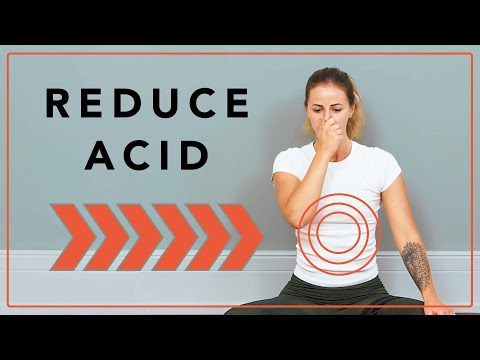
Breathing exercises for acid reflux: does deep breathing help?
It may help some people. The ring of muscle at the bottom of the food pipe sits inside the diaphragm, the main breathing muscle, and together they form the barrier that keeps acid down. The idea behind diaphragmatic (belly) breathing is to train that barrier.
In a small randomized trial (American Journal of Gastroenterology, 2012), 19 people with GERD that had not caused lasting damage to the food pipe did belly breathing exercises or no training for 4 weeks. The training group had less acid in the food pipe and better quality of life. After 9 months, people who kept practicing used less acid-reducing medicine. A 2026 review in the Journal of Clinical Medicine pooled 10 randomized trials with 476 people. It found a modest drop in reflux symptoms with diaphragmatic breathing, but no clear change in quality of life, and the authors called the evidence too limited for firm advice. So breathing exercises are a low-risk add-on, not a replacement for your treatment.
- Sit upright or recline slightly, not flat. Place one hand on your chest and one on your belly.
- Breathe in slowly through your nose for about 4 seconds, letting your belly push out against your hand. Your chest should stay fairly still.
- Breathe out slowly through pursed lips for about 6 seconds, letting your belly fall.
- Practice for 5 to 10 minutes, once or twice a day. A good time is before meals, not right after a big one.
Stretches for acid reflux that keep your head up
Stretching will not treat reflux on its own, but it keeps you loose and comfortable, and it pairs well with breathing practice. Choose stretches you can do sitting or standing, and keep your head above your stomach. Hold each one for 20 to 30 seconds and breathe slowly; do not hold your breath.
- Doorway chest opener: forearms on the door frame, step gently forward until you feel a stretch across the chest.
- Seated side bend: sit tall, reach one arm overhead and lean gently to the other side.
- Standing calf stretch: hands on a wall, one foot back, heel down.
- Seated hamstring stretch: sit at the edge of a chair, one leg straight with the heel on the floor, and lean forward from the hips with a straight back, only a little.
- Standing hip flexor stretch: hold a counter, step one foot back and tuck your hips under.
- Neck and shoulder rolls: slow circles, a few each way.
- Skip: toe touches, forward folds, child's pose, downward dog and any pose where your head drops below your waist, especially after eating.
Exercising with a stomach ulcer, and how to get started
The NIDDK says the two most common causes of stomach (peptic) ulcers are H. pylori infection and NSAID pain relievers such as ibuprofen, naproxen and aspirin. This matters for exercise: many people reach for these pills for sore muscles or joints. If you have an ulcer or a history of one, ask your doctor which pain reliever is safe for you, and when it is okay to be active while the ulcer heals, especially if it has bled. Gentle, upright activity such as walking is the easiest place to start. Get help right away if you notice black or bloody stools, vomit that contains blood or looks like coffee grounds, sudden severe belly pain, or dizziness and fainting.
To start, pick one upright activity, such as walking, and do it most days at an easy pace. Add light strength work twice a week once that feels routine. Keep a simple log of what you ate, when you exercised and any symptoms, so you can spot your own triggers. VitalStep can build a personalized, low-impact weekly plan with follow-along videos that avoids head-down moves.
- Weeks 1-2: 10 to 15 minute walks on most days, plus breathing practice.
- Weeks 3-4: build to 20 to 30 minutes. Add 2 short strength sessions with light bands, seated or standing.
- Weeks 5-8: aim for about 30 minutes on most days, mixing walking, cycling and strength, timed away from big meals.
When to stop exercising and get help
Stop right away and contact your doctor, or call emergency services if symptoms are severe, if you notice:
- Chest pain or pressure, especially with breathlessness, sweating, or pain spreading to the arm, neck or jaw. A heart attack can feel like indigestion, so call emergency services rather than assuming it is heartburn
- Food that feels stuck, or pain or trouble when you swallow
- Vomit that contains blood or looks like coffee grounds
- Black, tarry or bloody stools
- Sudden, sharp or severe belly pain that does not go away
- Dizziness, fainting or a racing pulse
- Vomiting that keeps happening, or weight loss you cannot explain (see a doctor soon)
- Heartburn on most days, or symptoms that are getting worse despite medicine (book a doctor visit)
Sample beginner week
An example to show how a balanced week can look. Adjust it to your energy, symptoms and your clinician's advice, or let VitalStep build one around your schedule.
| Day | Activity | Time | Intensity |
|---|---|---|---|
| Monday | Brisk walk before dinner + 5 min belly breathing | 30 min | Moderate (RPE 3-4/10) |
| Tuesday | Light standing and seated strength (band rows, sit-to-stands, wall push-ups) + upright stretches | 25 min | Light to moderate (RPE 3-4/10) |
| Wednesday | Upright stationary bike, 2 hours or more after a meal | 25-30 min | Moderate (RPE 3-4/10) |
| Thursday | Tai chi or gentle upright yoga (no head-down poses) + breathing practice | 20-30 min | Light (RPE 2-3/10) |
| Friday | Walk + light strength | 30 min | Moderate (RPE 3-4/10) |
| Saturday | Water walking, elliptical or a longer easy walk | 30-40 min | Light to moderate (RPE 3-4/10) |
| Sunday | Rest, or a slow walk after lunch and stretching | 10-20 min | Very light (RPE 1-2/10) |